


Buying guide · Juicers

The Best Cold-Press Juicers of 2026: A Chef's Guide

Chef Ana Machado in her kitchen

Written by Ana Machado

Updated September 2026 · 12 min read

Contains affiliate links · I may earn a commission

Two years ago I tested six slow juicers and picked the Hurom H400. Since then, every brand on that list has released something new, a $200 juicer became the best seller on Amazon, and I’ve spent a year juicing on a show floor instead of in a client’s kitchen. So I started over.

Retirement doesn’t have to be lazy strolls on the beach, Piña Coladas, and shuffleboard competitions. Although there’s nothing wrong with a Piña Colada, as long as it’s made with cold-pressed juice.

I “retired” from private chef work this year. I put that in quotes because this spring I was in Chicago at the National Restaurant Association Show pouring samples for eight hours a day, then doing it again in New York. For me, retirement means doubling down on what gives my life meaning, and that turned out to be this: getting the method I built for professional athletes into regular kitchens.

Chef Ana Machado with pro-athlete clients in a home kitchen
Cooking for pro athletes and their families is where the method started.

For years I was the executive chef for Nick Bosa of the San Francisco 49ers, the NFL’s 2022 Defensive Player of the Year. Cold-pressed juice was a fixture of his meal plan, especially during recovery, and I got to use my full tool belt to squeeze every bit of performance out of the food he ate. That was the dream job. But once you’ve built a methodology that works at that level, you’re never satisfied until you’ve shared it. Everyone should get to be the best version of themselves, whatever that looks like for them.

You can’t outwork a bad diet.
Chef Ana Machado with a group of professional athletes she cooks for
Twenty years of kitchens, and the same 5 a.m. green juice for everyone.

It wasn’t a sudden epiphany that got me here. I came to cold-pressed juice slowly, over years. As an immigrant, I had to fight to get into the kitchens I wanted to be in, and I would not have made it if I hadn’t taken my own diet as seriously as my clients’. That’s the one thing everyone chasing a goal has in common. And the easiest daily fix I know is a glass of homemade cold-pressed juice.

Which brings us to the machines. Juicing is a big part of my life and I want to help you, my community, so here is my research. I have over twenty years in professional kitchens (not that I’m bragging) and a lot of friends in the industry who lent me machines, opinions, and counter space.

Method

How I test juicers

I use the same four checks on every machine, and they haven’t changed since the first version of this guide.

01

Juice quality

Does the juice keep its color and taste fresh an hour later? Is there foam? Does the pulp come out dry? A good slow juicer gets every drop out, and you can see it in the pulp.

02

Ease of use

Assembly, feeding, and above all, cleanup. If a machine takes ten minutes to clean, you'll stop using it within a month. I've watched it happen in a lot of kitchens.

03

Versatility

Leafy greens, hard roots like ginger and beets, soft citrus, nuts for milk. A juicer that only handles apples and carrots isn't much of a juicer.

04

Noise

I've made juice at 5 a.m. in houses where athletes were still asleep. Noise matters.

Primer

What cold-press juicing is, if you’re new here

Centrifugal juicers shred produce with a fast spinning blade. That generates heat and pulls in air, and both degrade the nutrients you’re juicing for. Slow juicers (also called masticating or cold-press juicers) press instead of shred. An auger squeezes the produce against a strainer at a low RPM, the way you’d squeeze an orange by hand.

Charlie Wettlaufer at Goodnature, whose work I admire, ran lab tests on this. Cold-pressed juice started with 15% more vitamin A, 16.2% more folate, and 13.1% more vitamin C than centrifugal juice.

257%

more vitamin A than centrifugal juice after 72 hours in the fridge

350%

more vitamin C over the same 72 hours

In my kitchen, the practical difference is that cold-pressed juice doesn’t separate, and a batch still tastes right two days later. Every machine in this guide is a slow juicer. The question is which one.

At a glance

My 2026 picks, in order

  1. Hurom H80$749
    4.9 / 5

    Overall winner, daily and family juicing

  2. Kuvings AUTO10 Plus$769.99
    4.6 / 5

    Biggest batches

  3. Kuvings REVO830$699.99
    4.5 / 5

    Carrot and celery juicers

  4. Tribest Greenstar Elite$599.95
    4.4 / 5

    Leafy greens and wheatgrass

  5. Canoly C16About $200
    4.2 / 5

    Budget pick

Hurom H80 Slow Juicer
1Winner

Hurom H80 Slow Juicer

4.9 / 5$749

Pros

  • 2-liter self-feeding hopper with a larger inlet, so you can keep adding produce while it runs
  • Spiral Blade in the hopper keeps kale and celery moving instead of clogging
  • 50 RPM slow squeeze, low-pulp juice, very dry pulp
  • Three strainers in the box: fine for juice, coarse for smoothies and thicker juice, ice cream for sorbet
  • Dishwasher-safe components
  • Quiet 150-watt AC motor
  • BPA-free, made in South Korea
  • 15-year warranty on motor and parts

Cons

  • $749
  • About 18 inches tall, so measure under your cabinets
  • Large pits (peaches, plums) need to come out before juicing

The H400 was my winner last time, and the H80 is the next step from the same family. It fixes the one thing I still used to babysit: feeding.

The hopper holds two liters of produce. I load it, turn it on, and walk away to prep something else. The inlet on top is bigger than the H400's, so when the level drops I add more without stopping. When I'm making a gallon of green juice, that's the difference between standing at the machine and getting on with the day.

The Spiral Blade is the new part. It sits in the hopper and keeps fibrous greens moving down into the auger. Kale and celery are the two ingredients most likely to stall a slow juicer, and they're the two I juice most. The H80 hasn't stalled on me.

Juice quality is what I expect from Hurom's low-pulp line. At 50 RPM the auger presses rather than tears, there's almost no foam, and the pulp is dry to the touch. I use the fine strainer for nearly everything. The coarse strainer is for thicker vegetable juice or a smoothie base, and the ice cream strainer turns slightly thawed frozen fruit into sorbet in one pass.

Cleanup is the reason I'd tell most people to buy this one over the Kuvings. The parts are dishwasher safe, and a rinse under the tap handles it on the days I don't want to wait. Of the five machines here, this is the only one I'd call quick to clean without qualifying it.

The objection is price. It costs about the same as the Kuvings AUTO10 Plus and more than everything else on this list. If that's the issue, the Canoly at the bottom is the answer. If it isn't, this is the machine.
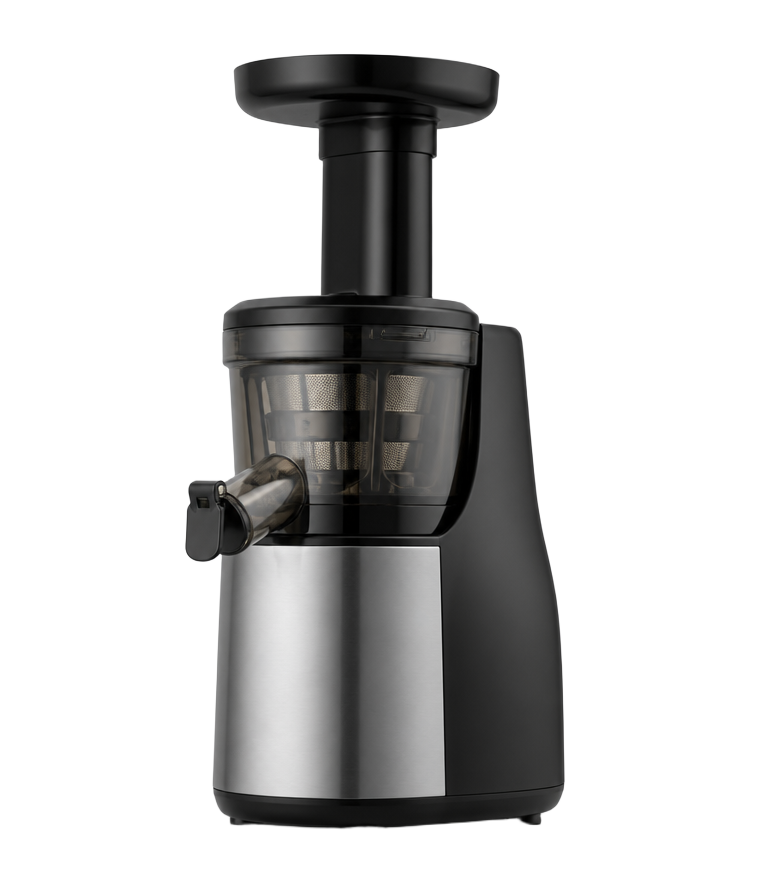
Kuvings AUTO10 Plus Hands-Free Slow Juicer
2Runner-up

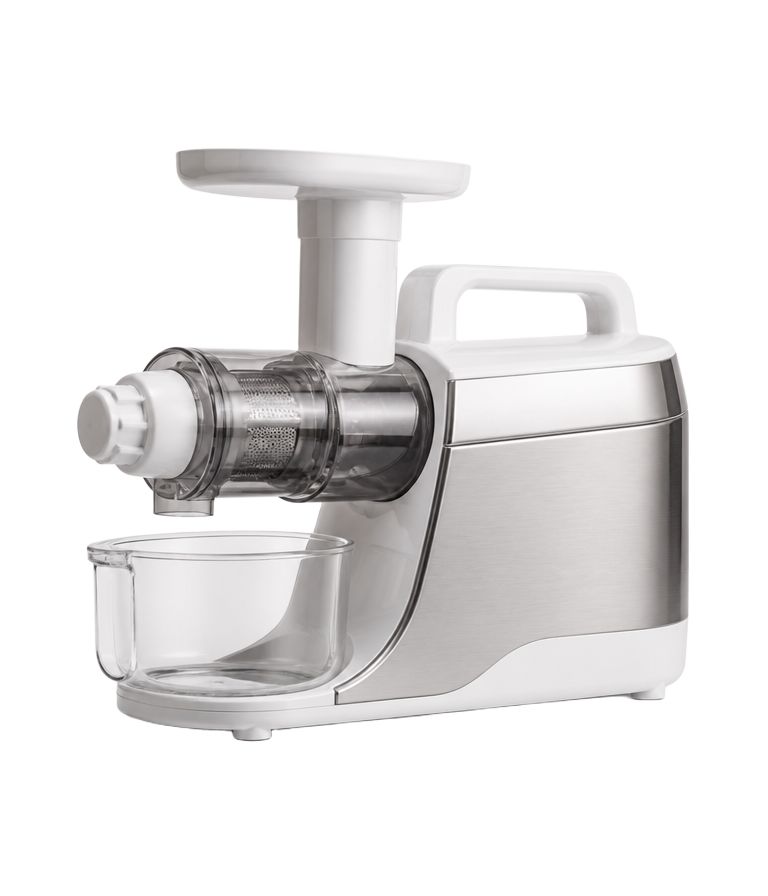
Kuvings AUTO10 Plus Hands-Free Slow Juicer

4.6 / 5$769.99

Pros

  • Largest hopper of the group: 2.7 liters, or 4 liters with the snap-on extension
  • 6.5-inch chute takes whole apples, beets, and long carrots without chopping
  • Three strainers (juice, smoothie, sorbet) plus a pulp strainer in the box
  • 240-watt motor, 60 RPM
  • 15-year warranty on parts and motor

Cons

  • None of it is dishwasher safe; Kuvings ships three cleaning tools for a reason
  • Lots of parts and crevices to hand wash
  • 20 inches tall with the extension; it may not fit under standard upper cabinets
  • Heavy at 16.5 pounds
  • Slightly more expensive than the H80

If you make juice in volume, the AUTO10 Plus is the H80's only real competition. The hopper extension takes capacity to 4 liters, and the 6.5-inch chute means whole produce goes in unpeeled and uncut. Load it, turn it on, and it's hands-free from there. For a family of five or a weekly batch-juicing routine, that's a strong argument.

The juice is good. Kuvings runs a bit faster at 60 RPM, and I get a little more foam than from the H80, but the yield is close and the pulp comes out dry. Kuvings' own customer reviews note the pulp can be very dry, which is what you want.

The reason it's second and not first is cleanup. Nothing goes in the dishwasher. TechRadar's reviewer called cleaning "the hardest part of using this machine" and said the same thing I found: a lot of parts, a lot of nooks, and every one of them washed by hand. For a machine you're supposed to use every morning, that's a real cost. It's also tall. Check your cabinet clearance before you buy.

Kuvings REVO830 Whole Slow Juicer
3Best for celery and carrots

Kuvings REVO830 Whole Slow Juicer

4.5 / 5$699.99

Pros

  • Auto-Cut Chute chops carrots, celery, and cucumbers as they feed, which is the hardest job in juicing
  • 3.5-inch flip-gate chute for whole apples and beets
  • Kuvings' most powerful home motor, rated for 45 minutes of continuous use
  • 50 to 60 RPM, quiet
  • Smoothie and sorbet strainers included
  • 15-year warranty

Cons

  • Not hands-free: you feed it piece by piece
  • Mesh strainer means more scrubbing than the H80
  • Some owners report cracked strainers with citrus; Kuvings' own advice is to quarter limes and lemons first
  • Bulky at 16.5 pounds

The REVO830 solves a specific problem very well. Long, stringy produce (celery, carrots, cucumber) is what wraps around augers and stalls machines. The REVO830's second chute feeds those straight into a screw that chops as it presses. If your morning juice is mostly celery, this is the machine built for you.

What you give up is the walk-away hopper. You stand at the REVO830 and feed it, and for me that's the difference between a juicer I use daily and one I use on weekends. The motor is the strongest here and it'll run for 45 minutes straight, which matters if you're processing a case of produce. But for most people, the AUTO10 Plus or the H80 will fit the routine better.

Tribest Greenstar Elite Twin Gear Juicer
4Best for greens

Tribest Greenstar Elite Twin Gear Juicer

4.4 / 5$599.95

Pros

  • Twin-gear design that outperforms single-auger machines on leafy greens, wheatgrass, and sprouts
  • Tom's Guide measured a 75% yield on apple and kale, third best of everything they tested
  • 110 RPM twin gears with magnetic and bioceramic technology, and the reduced-oxidation claim held up in their testing
  • Also makes nut butters, sorbet, and pasta with the included attachments
  • Every part except the safety hood is dishwasher safe
  • 12-year warranty

Cons

  • No hopper; you push produce through the chute by hand, and it takes some pressure
  • Horizontal layout with a big footprint (12.4 x 6.8 x 18.6 inches, 17.4 pounds)
  • The longest learning curve of the five for assembly and disassembly
  • Small 24-ounce capacity for a machine this size

Chefs who juice wheatgrass swear by twin-gear machines, and the Greenstar Elite is the one they mean. Two interlocking gears crush and grind rather than press, and on fibrous greens that produces more juice than any vertical machine here. If greens are 80% of what you juice, this is a serious option at a lower price than the top three.

It's also the least convenient. There's no hopper. You feed it by hand and push, and the first few times you take it apart you'll be checking the manual. It's a horizontal machine, so it takes counter length instead of height. I respect it, I've used it, and I wouldn't put it in a beginner's kitchen.

Canoly C16 3-in-1 Cold Press Juicer
5Budget pick

Canoly C16 3-in-1 Cold Press Juicer

4.2 / 5About $200on Amazon (list $299.99)

Pros

  • A self-feeding hopper and a 6-inch chute at a quarter of the price of the H80
  • 90-ounce hopper (2.65 liters), about the same as the H80
  • 250-watt brushless AC motor, quiet
  • Juice, sorbet, and nut milk strainers
  • Dishwasher safe
  • Light at 13.9 pounds

Cons

  • Pulpier juice; owners on Amazon say to strain it if you want a store-bought texture
  • Celery needs cutting into 1- to 2-inch pieces, per Canoly's own guidance
  • Warranty is unclear: Canoly advertises a 15-year motor warranty, the Amazon listing says 1 year
  • New brand with a short track record

I didn't expect to include a $200 juicer. Then the Canoly became the best-selling juicer on Amazon, three different clients asked me about it, and I bought one.

For the money, it's remarkable. You get a real hopper, a wide chute, a quiet motor, and three strainers, which two years ago would have cost you $500 from anyone. The juice is fine. It's not as clear as the H80's and there's more pulp in the glass, but if you're new to juicing and not sure you'll stick with it, this is the cheapest way to find out with a machine that won't frustrate you.

Where it falls short is in the details. Celery needs chopping. The juice benefits from a strainer. And the warranty situation bothers me: the brand says 15 years on the motor, the Amazon listing says one year, and I'd want that in writing before I counted on it. If you can stretch to the H80, you're buying a machine that will still be running in fifteen years. If you can't, buy this one and start juicing.

Specs

Side by side

Swipe the table to compare →

SpecHurom H80Kuvings AUTO10 PlusKuvings REVO830Tribest Greenstar EliteCanoly C16
Price$749$769.99$699.99$599.95~$200
TypeVertical, self-feedingVertical, self-feedingVertical, manual feedHorizontal twin gear, manual feedVertical, self-feeding
Speed50 RPM60 RPM50–60 RPM110 RPMNot published
Hopper2 L2.7 L (4 L with extension)NoneNone2.65 L (90 oz)
Chute5.4 in6.5 in3.5 in + Auto-CutNarrow6 in
Motor150 W240 W240 W200 W250 W
StrainersFine, coarse, ice creamJuice, smoothie, sorbet, pulpJuice, smoothie, sorbetFine, coarse + attachmentsJuice, sorbet, nut milk
Dishwasher safeYesNoNoMostlyYes
Weight13.7 lb16.5 lb16.5 lb17.4 lb13.9 lb
Height18.0 in17.75–20.25 in18 in6.8 in (horizontal)7.7 in (horizontal)
Warranty15 yr15 yr15 yr12 yr1 yr (listing) / 15 yr motor (brand)

Verdict

Which one should you buy?

  • Buy the Hurom H80 if you juice most days, you're feeding more than one person, and you want the cleanup to take two minutes. It's the best home juicer I've used and the one I'd put in a client's kitchen today.

    $749
  • Buy the Kuvings AUTO10 Plus if you batch-juice in volume and you don't mind hand washing.

    $769.99
  • Buy the REVO830 if celery and carrots are most of what you juice and you're fine feeding it yourself.

    $699.99
  • Buy the Greenstar Elite if you're serious about greens and wheatgrass and you've owned a juicer before.

    $599.95
  • Buy the Canoly C16 if $200 is the budget. It's a real slow juicer, and it'll tell you whether you're a juicer.

    About $200

Last word

Hurom H80 is my top choice. What’s yours?

The lineup changed a lot in two years. Hoppers went from a premium feature to standard. A $200 machine now does what a $500 one did. And the gap between the top two came down to a single question: do you want to hand wash your juicer every morning?

I don’t. That’s why the H80 wins.

As always, that’s one chef’s opinion. I tried to be as objective as I could, and I’d encourage you to judge these machines through the lens of your own kitchen, your own budget, and what you actually juice.

And I did get my Piña Colada, by the way. Cold-pressed pineapple.

Top pick

Hurom H80 · $749

See it